Static, Stretch Marks and Secrets: Inside Britain's Obsession with Hunting Down Forgotten VHS
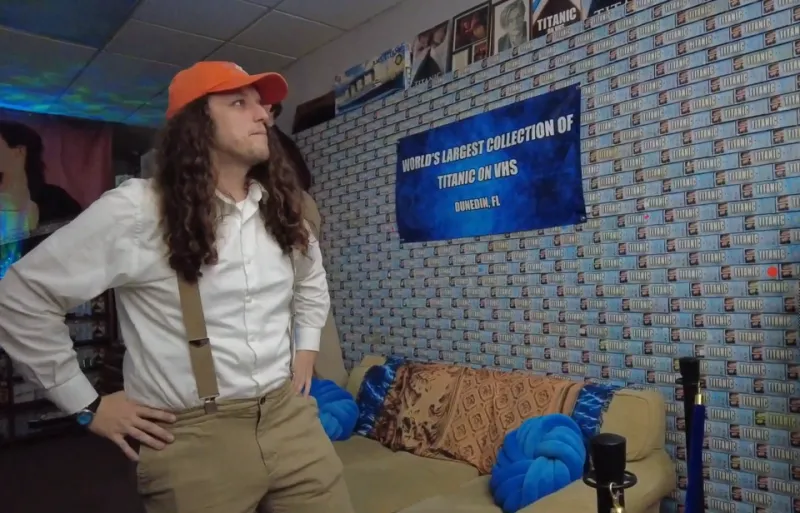
Photo: Collect&Reflect on YouTube, CC BY 3.0, via Wikimedia Commons
The tape doesn't rewind cleanly. There's a wobble in the tracking, a faint horizontal tear across the lower third of the frame, and the colour has shifted into something warm and slightly wrong — like a memory of a memory. You're watching a low-budget British horror film from 1983 that was never released on DVD, never uploaded, never discussed on any platform that an algorithm could index. You found the tape in a carrier bag at a car boot sale in Lincolnshire for 20p.
This is the VHS experience in 2024, and for a specific, passionate, and rapidly growing corner of the UK's indie film scene, it's not a compromise. It's the whole point.
Why Tape, Why Now?
The straightforward explanation is preservation — or rather, the lack of it. An enormous volume of films released on VHS between the late 1970s and mid-1990s never made the transition to any digital format. Straight-to-video releases, regional documentaries, low-budget genre films, obscure foreign imports with hand-typed labels — thousands of titles that exist only on magnetic tape, in varying states of decay, scattered across the nation's lofts, charity shops, and car boot sales.
For collectors and programmers who care about the full breadth of cinema history, ignoring tape isn't really an option. If you want to see it, you go looking for it.
But the resurgence goes deeper than mere archival necessity. There's a growing rejection, particularly among younger film enthusiasts, of the frictionless, algorithmic, infinitely abundant streaming experience. When everything is available instantly, nothing feels discovered. The thrill of the find — of pulling something strange and unfamiliar from a crate and not knowing what you're going to get — is something streaming has essentially abolished.
"I'm not anti-streaming," says Joel, a Manchester-based programmer who screens VHS alongside 16mm at occasional underground events. "But I've noticed that when I'm watching something on a platform, I'm always half-aware of everything else I could be watching instead. With a tape, that's it. That's what you've got. There's something almost meditative about it."
The Tape Hunters
The community that's grown up around VHS in Britain is wonderfully heterogeneous. You've got hardcore collectors chasing specific releases — rare pre-cert horror tapes, early UK pressings of American exploitation films, bootleg recordings of televised concerts and sporting events. You've got programmers sourcing material for screenings. You've got artists and filmmakers drawn to the aesthetic properties of degraded tape. And you've got a growing number of people who simply find the format's imperfections more honest, more human, than the clinical clarity of 4K.
The hunting grounds are well-established if you know where to look. Charity shops remain the most democratic source — Oxfam, Sue Ryder, and British Heart Foundation branches in university towns and seaside resorts are particularly productive, for reasons nobody has fully explained. Car boot sales, especially in rural areas, turn up extraordinary material. Online auction sites have become more picked-over but still yield surprises. And there's a thriving informal trade between collectors via social media groups and zines.
"The best find I've had recently was a tape of a documentary about a Merseyside steelworks that was made by the workers themselves in 1979," says Priya, a film archivist and collector based in Liverpool. "No commercial release, no digital copy anywhere that I can find. Just this tape that someone had kept for forty-five years. It's extraordinary."
The Ethics of the Hunt
The VHS revival does raise genuine questions that serious collectors tend to grapple with openly. Copyright, for one — much of what circulates in the tape world exists in legal grey zones, particularly bootlegs and recordings of broadcast material. The question of who has the right to screen, copy, or distribute material that rights holders have effectively abandoned is genuinely complicated.
There's also the question of preservation versus circulation. A tape that gets passed around, copied, screened repeatedly, is a tape that degrades. Collectors disagree about the right balance between keeping material alive and accessible and protecting it from further damage.
"I try to digitise anything significant before it deteriorates further," says Priya. "Even if I can't circulate the digital copy legally, at least the content is preserved. The tape itself isn't going to last forever."
The community broadly operates on principles of stewardship rather than ownership — the idea that you're the temporary custodian of something that belongs, in some meaningful sense, to cinema history.
VHS at the Festival Fringe
One of the more interesting developments in recent years has been the appearance of VHS-sourced material at the fringes of Britain's independent film festival circuit. Late-night and fringe events at festivals like Flatpack in Birmingham, Kinokulture in Aberystwyth, and various one-off events in London and beyond have started incorporating tape screenings — sometimes as a deliberate aesthetic statement, sometimes simply because the tape is the only way to see the film.
The projection of a VHS tape onto a large screen is a distinct experience. The image is soft, textured, imperfect. The tracking errors and stretch marks become part of the film's presence. Audiences who grew up with streaming often find it unexpectedly moving — something about the visible fragility of the format, the sense that you're watching something that could be lost, that has already partly been lost, gives the experience a particular weight.
"There's no irony in it for us," says Joel. "We're not screening tapes because it's quirky or retro. We're screening them because the films on them are worth watching and this is the only way to watch them."
The Streaming Counter-Argument
It would be easy to frame the VHS revival as simple Luddism — a reflexive rejection of convenience in favour of difficulty. That's not quite right. Most of the collectors and programmers in this world use streaming services. They're not ideologically opposed to digital distribution.
What they're opposed to is the idea that streaming is sufficient. That if something isn't on a platform, it doesn't exist. That curation by algorithm is equivalent to curation by human passion and knowledge. That cinema history begins and ends with what's currently licensed and commercially viable.
The tape hunters are filling a gap that the digital revolution created when it moved on and left thousands of films behind. They're doing it in car boots and charity shops and draughty screening rooms, with battered machines and dodgy tracking, and they're finding extraordinary things.
The static is part of the signal. Always was.