Hops and Handhelds: Why the Back Room of a Pub Is Britain's Most Honest Cinema
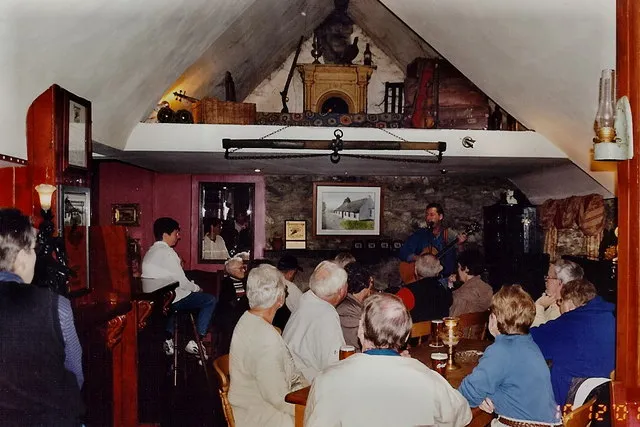
Photo: Joseph Mischyshyn, CC BY-SA 2.0, via Wikimedia Commons
The room above the bar
You know the one. Up a narrow staircase, past the toilet, through a door marked Function Room, into a space that smells faintly of last night's quiz and holds about forty chairs if nobody minds sitting close. There's a projector on a shelf, a sheet or a proper screen depending on the budget, and a plastic tub by the door for donations.
This is where a decent chunk of Britain's most interesting cinema actually happens. Not in the grand auditoriums with the listed facades, but in the upstairs rooms of pubs that have quietly decided their Tuesday nights could use a bit more Ingmar Bergman.
Licensing, or why the paperwork is the hard bit
Putting on a film in public isn't just a case of pointing a laptop at a wall. You need the right to exhibit, you need the distributor's permission, and you need the premises licence to cover it. A pub's licence will usually permit the sale of alcohol and often regulated entertainment, but film exhibition is its own category and local authorities vary enormously in how they read it.
'We spent four months on the licence and about four hours on the programming,' one landlord in the north east tells me, cheerfully. 'The council were fine. It was the distributor paperwork that nearly finished us off.' Screening fees vary wildly — a cult title from a small archive can cost a couple of hundred quid, a bigger independent release considerably more — which is why so many pub nights stick to public domain oddities, locally made shorts and whatever the programmer can beg, borrow or license cheaply.
It's an unglamorous foundation for a scene, and it's the reason the scene is real. Nobody is doing this for the margin.
Beer improves a difficult film
Here's the thing the arthouse purists won't say out loud: a pint helps. Not because the film is bad, but because the room is different. A pub screening removes the pressure of the velvet seat. You're not being examined. You can shift in your chair, you can glance at your phone under the table without feeling like a war criminal, you can lean over and whisper 'what's happening' to the person next to you and get an answer.
That's how a lot of people get into slower, stranger, older cinema. Not through a lecture, but through a Tuesday night in a back room with a drink in their hand and no expectation of being impressed.
A programmer in Sheffield puts it well: 'We show a lot of stuff that would empty a cinema. Put it in a pub with a decent crowd and a bar and suddenly it's a night out. The film hasn't changed. The room has.'
What the landlords get out of it
Cynics assume it's all about selling pints to a captive audience. The reality is more interesting. Landlords talk about the same handful of things: a quieter night turned into a busy one, a regular crowd who now come in on other days, and the strange civic pride of being the pub that shows the weird stuff.
There's also the sense of a room being used properly. A function space that sits empty Monday to Thursday is a dead asset. Give it forty folding chairs and a screen and it becomes the reason somebody leaves the house in November.
The audience problem, and the audience solution
The risk is obvious. A pub crowd can be loud, distracted, and prone to treating a screening as background. The successful nights solve this with small rituals rather than rules: a short introduction, a hard start time, lights down properly, and a landlord willing to have a quiet word with the one table that won't settle.
It helps that the audience is usually self-selecting. People who climb a staircase to watch a 1974 documentary about pylons are, broadly, there for the pylons.
Hops over celluloid
The smell of a pub — yeast, cleaning fluid, faintly warm carpet — becomes part of the memory of the film. You'll forget the second act of something you saw in a multiplex with reclining seats. You will not forget the night you watched a scratched print of a forgotten British B-picture while someone's dog wandered between the rows and the landlord rang the bell at the interval.
That's not a compromise on cinema. It's cinema doing what it was always supposed to do: turning a room of strangers into something briefly shared.