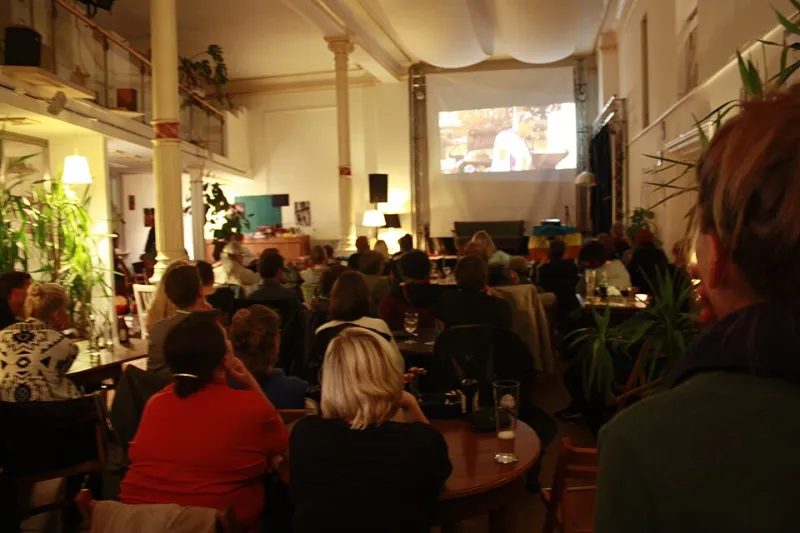
Loudly Wrong in Public: In Defence of a Proper Film Argument

Photo: marneejill from Canada, CC BY-SA 2.0, via Wikimedia Commons
Remember When Getting It Wrong Took Time?
There was a period — let's call it the age of the late-night pub post-mortem — when your opinion of a film was something you arrived at slowly. You saw the film, possibly on a Tuesday at a fleapit in a town with one screen, and then you spent the walk to the bus stop arguing about it. You got it wrong. Your mate corrected you. You corrected them back. Nobody's reputation was destroyed. You went again the following week.
Compare and contrast with the current arrangement, in which a film's critical standing is effectively settled within hours of release by an international committee operating in real time. The hot take is written before the film has finished screening in Leicester Square. The consensus calcifies before most of the country has bought a ticket. By the time the film reaches an indie screen in Sheffield or Swansea, the audience arrives pre-programmed with what they're allowed to think.
Something has been lost here, and it's worth naming: the process of disagreement.
The Consensus Machine
The problem isn't that people disagree online — they disagree constantly and viciously. It's that the disagreement is rarely about the film. It's about the take. Online film discourse rewards positioning, not engagement: be early, be extreme, be quotable. The result is a strange flattening effect where even arguments look identical in structure. Everything is either overrated or underrated, a masterpiece or a disaster, and the space in between — where most films actually live, and where honest criticism happens — has eroded.
Cult cinema, in particular, suffers from this. Cult films are, by definition, films that people disagreed about for a long time. Withnail & I wasn't beloved on release. Performance was shelved. The films we now treat as sacred British texts were once just films some people walked out of. That's not a bug of the cult canon — it's the mechanism that built it.
A consensus machine doesn't build cult classics. It builds blockbusters with good ratings. It optimises for agreement, and agreement is the death of the weird.
Where Argument Still Lives
Here's the good news, though, and it's the reason you're reading this on a site like ours: the arenas where real film argument survives are physical ones.
Go to an indie cinema Q&A and watch someone stand up and tell a filmmaker, to their face, that the ending didn't work for them. Watch the filmmaker defend it. Watch the room split. That's a live negotiation with stakes and texture, and no thread can replicate it.
Go to a cult screening — an interactive one, a singalong, a midnight show — and you'll find an audience that has earned its opinion through repetition. These people have seen the film eleven times. They know what they think. Their love is specific, granular and completely unbothered by the aggregate rating.
And then there are the fanzines — the photocopied, stapled, badly-spelled love letters to particular films and genres that still circulate at conventions and through independent cinemas. They're opinionated in the old sense: committed, partisan, occasionally outrageous, and always written by someone who clearly watched the thing more than once. You can be loudly wrong in a fanzine and the worst consequence is a furious letter in the next issue. That's a healthy ecosystem.
The Case for Being Wrong
The defence of disagreement isn't contrarianism for its own sake. It's that being wrong in public is how taste develops. Every passionate film person you've ever met built their taste by defending something indefensible, quietly realising they were mistaken, and revising. That process requires space — space to hold a bad opinion long enough to learn from it.
The current online model doesn't allow revision. Opinions are permanent records, and admitting you've changed your mind reads as weakness rather than growth. So nobody changes their mind. They just dig in, or log off.
The indie cinema, the film society, the festival Q&A, the stapled-together zine — these are the places where the slow, messy, human version of film criticism still happens. They're worth defending not out of nostalgia, but because they're the only environments where the next generation of cult classics can be discovered rather than pre-ratified.
So here's a modest proposal. Next time you see a film at your local independent screen, resist looking at the consensus before you go in. Sit with your reaction. Get it wrong. Then find someone who got it differently wrong, and argue about it on the way to the bus stop.
The film will still be there tomorrow. So will the argument. That's rather the point.