Two for the Price of One: How the Double Bill Became Indie Cinema's Sharpest Weapon
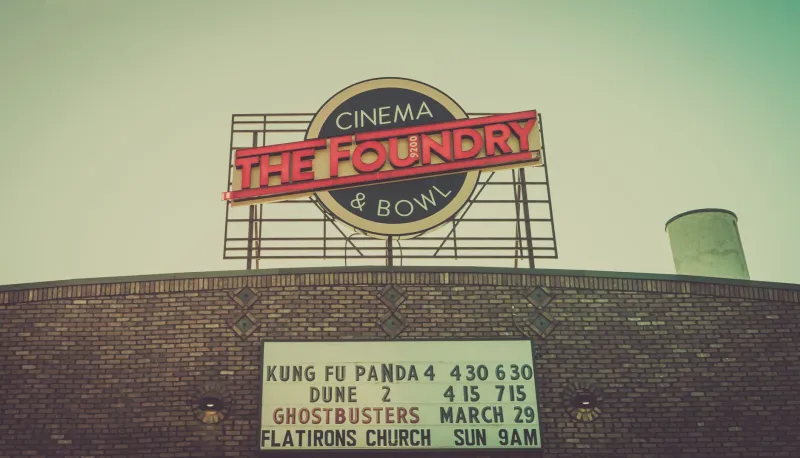
There's a particular kind of cinema evening that sticks with you. Not just the film — the sequence. The way one story bleeds into the next, the interval pint giving you just enough time to let the first film settle before the second one cracks it open again. Britain's indie cinemas have quietly figured out that this experience, the double bill in full ceremonial glory, might be their most powerful card yet.
The format isn't new, obviously. Double features were once the bread and butter of British cinema culture, a hangover from the days when a trip to the pictures was an all-evening affair and the B-movie existed specifically to pad the programme. But somewhere between the multiplex boom of the nineties and the streaming wars of the last decade, the double bill got quietly retired. Multiplexes couldn't make the numbers work. Studios didn't want their prestige releases sharing a marquee with anything else. And so the format faded.
Now it's coming back. And the people bringing it back aren't doing it out of nostalgia.
The Curatorial Argument
"It's not about showing two films," says Priya Mehta, programmer at a beloved independent cinema in Leeds. "It's about building an argument. You're saying: these two things, together, tonight, will do something to you that neither of them could do alone." Mehta has been developing double-bill evenings for the past three years, pairing everything from classic Hammer Horror with contemporary body-horror shorts to early Mike Leigh with a recent Ken Loach. The response, she says, has consistently outperformed standard single-feature evenings in terms of both attendance and post-screening engagement.
"People stay. They talk. They argue. They come back the following week because they want to know what we're going to do next." That last part — the what next — is increasingly where the value lies. In a landscape where any individual film is theoretically available to watch at home within months of release, the double bill offers something streaming simply cannot manufacture: editorial intent. Someone made a decision. Someone thought about this.
That sense of curation, of being guided by a sensibility rather than an algorithm, is precisely what draws people to indie cinema in the first place. The double bill just makes that sensibility visible.
Pairing as Craft
The mechanics of a good double bill are trickier than they look. The obvious approach — thematic matching, a director retrospective, a genre deep-dive — works well enough but rarely produces the most memorable evenings. The programmers who seem to be generating the most buzz are the ones willing to create unexpected friction.
Dan Okafor, who programmes late-night events at an arthouse space in Bristol, describes his method as "productive discomfort". He recently paired Agnès Varda's Cléo from 5 to 7 with Jonathan Glazer's Under the Skin, a combination that sounds jarring on paper but generated one of his highest-attended evenings of the year. "Both films are about a woman moving through a city, being watched, being objectified, processing something enormous internally. But they're sixty years apart and stylistically completely different. The contrast does the critical work for you."
Okafor says the key is ensuring audiences feel the connection without having it spelled out. "If you have to explain why the pairing works in the programme notes, you've probably chosen wrong. It should hit people in the interval. You want them going to the bar and immediately turning to whoever they came with."
Not every programmer agrees on the importance of obscuring the logic. Some take a more didactic approach, using the double bill as an explicitly educational tool — particularly in venues that skew towards younger audiences or film students. At a community cinema in Glasgow, programmer Siobhan Reid runs a monthly series called Two Sides that pairs a canonical film with a lesser-known work that either influenced it, responded to it, or was unfairly overshadowed by it. "There's a generation of film lovers who've seen all the classics on a laptop. Giving them context, giving them the conversation between films, that's what makes a cinema visit feel worth it."
The Numbers Behind the Revival
Anecdotal enthusiasm is one thing. But is the double bill actually shifting tickets? The evidence, while patchy, is encouraging. Several indie cinemas that have incorporated regular paired programming into their schedules report that double-bill evenings consistently outperform equivalent single-feature screenings in both advance bookings and walk-up sales. One venue in Manchester noted that their monthly double-bill night had a repeat-attendance rate nearly double that of their standard programme.
Part of this is simple economics — audiences feel they're getting better value, particularly when ticket prices have crept upward across the board. But programmers are keen to stress it's not just about perceived bargain. "People book double bills further in advance," says Mehta. "It becomes an event. You're not just deciding to see a film on a Tuesday — you're committing to an evening."
That shift from casual visit to committed occasion is significant. It mirrors the logic behind away-day cinema culture more broadly: the idea that the journey, the ritual, the full experience is the point. A double bill is a micro version of that. You're not popping in. You're going.
The Multiplex Can't Touch This
For all the talk of streaming being indie cinema's existential threat, the double bill revival is a reminder that the real competitive gap is with the multiplex. Major chains operate on turnover — screens cleared and reset as quickly as possible, maximum showings per day, no room for four-hour programming blocks that require a different kind of operational thinking.
Indie venues, by contrast, can afford to think in experiences rather than slots. They can dim the lights for an interval, put on a record, let the room breathe. They can programme a film that's thirty years old alongside something that came out last month and call it a deliberate act. That flexibility isn't a consolation prize for not having twelve screens and a Tango Ice Blast machine. It's the actual product.
"The multiplex is never going to do this," says Okafor, without a trace of triumphalism. "Not because they can't logistically — they could. But because it requires a point of view. And a point of view is a risk. We're small enough that a risk is just a Tuesday."
Worth the Trip
If you haven't been to a properly programmed double bill recently, it's worth going out of your way for one. Check what your nearest indie cinema has on — and if they're not running paired programming yet, it might be worth asking why not. The format rewards commitment. You'll need a few hours, a willingness to let someone else set the agenda, and ideally a companion who's up for a proper debrief in the car on the way home.
That's the thing about the double bill. It doesn't just give you two films. It gives you something to say about them.