Village Halls and Velvet Seats: How Britain's Film Societies Are Quietly Changing Who Cinema Belongs To
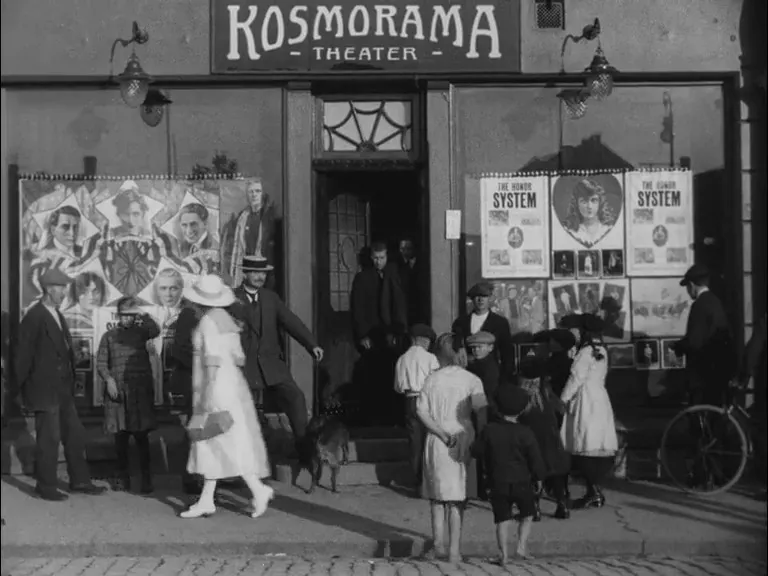
Photo: Hans Berge, PDM-owner, via Wikimedia Commons
There's a particular kind of magic in watching a subtitled Romanian drama in a room that smells faintly of instant coffee and damp coats. It shouldn't work. The fold-out chairs are unforgiving, the projection screen has a slight lean to it, and someone near the back is definitely rustling a packet of biscuits they smuggled in from home. And yet — somehow, it absolutely does work. In fact, for a growing number of British film lovers, it's precisely this kind of experience they're seeking out.
Britain's film society scene is older than most people realise. The London Film Society launched in 1925, screening Soviet cinema at a time when it was essentially contraband. Nearly a century later, the impulse hasn't changed much — show films that matter, to people who care, in a space that feels like it belongs to everyone in the room.
What has changed is the scale. There are now hundreds of film societies operating across the UK, from the Highlands to the Home Counties, and many of them are quietly thriving.
Who's Actually Running These Things?
The honest answer is: people with full-time jobs and a frankly alarming dedication to cinema.
Take Miriam, who co-programmes a film society operating out of a village hall in Shropshire. She works four days a week as a secondary school librarian, spends most of her evenings corresponding with distributors, and somehow manages to pull together a ten-film season every autumn and spring. "We show things that would never come within fifty miles of us otherwise," she says. "Last season we had a Taiwanese New Wave retrospective. We had seventeen people turn up to watch A Brighter Summer Day on a Tuesday night in February. That felt like a genuine victory."
This is the texture of the film society world — modest victories that feel enormous. A sold-out screening of a 1970s Yugoslav partisan film. A post-show discussion that runs so long the caretaker has to physically ask everyone to leave. A first-time attendee who came because their neighbour dragged them along and is now, three seasons later, on the programming committee.
The Programming Challenge
Building a season for a film society audience is a genuinely different discipline from mainstream exhibition. You're not chasing footfall — you're cultivating trust. Programme something too obscure and you lose the casual members; play it too safe and you lose the reason people joined in the first place.
The best programmers develop an instinct for the sweet spot. A classic that half the room hasn't seen paired with something genuinely challenging. A filmmaker retrospective that builds across multiple evenings. A themed strand — road movies, films about grief, cinema from a single country — that gives the season a shape audiences can follow.
Funding is the perpetual headache. Most film societies operate on shoestring budgets, relying on membership fees, small grants from local arts councils, and the occasional windfall from a successful fundraiser. The BFI's Film Audience Network has been a lifeline for many, offering both financial support and programming resources, but competition is fierce and the paperwork is substantial.
"We applied for a development grant three times before we got anything," admits Dara, who runs a film society in a former mill town in West Yorkshire. "But the application process itself was useful — it made us think seriously about what we were actually trying to do and who we were doing it for."
The Social Ritual Nobody Talks About
Here's the thing that doesn't show up in any funding application: the social glue.
Film societies, at their best, function as genuine communities — the kind that are increasingly hard to find in British public life. Members look forward not just to the films but to the people. The retired teacher who always has a devastating one-liner ready for the Q&A. The couple who met at a screening of The Conformist six years ago and still attend every session. The teenager who turned up alone one evening and has barely missed a screening since.
Many societies build deliberately around this. Pre-screening drinks. Post-film discussions that aren't chaired so much as loosely facilitated. Zines and reading lists for the genuinely obsessed. Some have started hosting film-adjacent events — talks, workshops, book swaps — that keep the community active between seasons.
"The film is almost the excuse," says Miriam. "What people are really coming for is the conversation. The sense that there are other people out there who care about the same things you do."
Foreign Language, Archive, Experimental: The Stuff That Doesn't Get Shown Anywhere Else
One of the most valuable functions film societies serve is simply keeping certain kinds of cinema visible. Foreign-language film has been squeezed out of most commercial venues outside major cities. Archive and repertory programming is rarer still. Experimental work — artists' film, essay cinema, documentary hybrids — barely registers on most exhibition radars at all.
Film societies fill that gap. They're often the only places in their towns where you can watch a restored print of a 1960s Italian genre film, or a new documentary from a filmmaker who'll never get a theatrical release, or a programme of short films curated around a theme that no distributor would ever greenlight as a commercial proposition.
For younger audiences especially, this can be genuinely revelatory. Growing up with algorithmic streaming, many people in their twenties have never experienced the specific pleasure of discovering something they didn't know to look for — of having their taste expanded by someone else's passion and expertise.
Getting Involved
If you've never been to a film society screening, the easiest way in is usually to just turn up. Most operate on a membership basis but welcome guests, and the atmosphere is almost universally welcoming rather than cliquey. The BFI's Film Hub network is a good starting point for finding societies near you, and Cinema for All — the national body supporting community cinema — maintains a searchable directory.
If there isn't one near you, starting one is more achievable than it sounds. Cinema for All offers guidance and support for new groups, and the infrastructure — a venue, a digital projector, a licence, a mailing list — is genuinely within reach of a small group of motivated people.
The multiplexes aren't going anywhere. But neither, it turns out, are the people who want something different. In village halls and church basements and converted libraries across Britain, someone is setting up chairs, testing the projector, and getting ready to show something brilliant to a room full of people who showed up because they actually wanted to be there.
That feels worth celebrating.